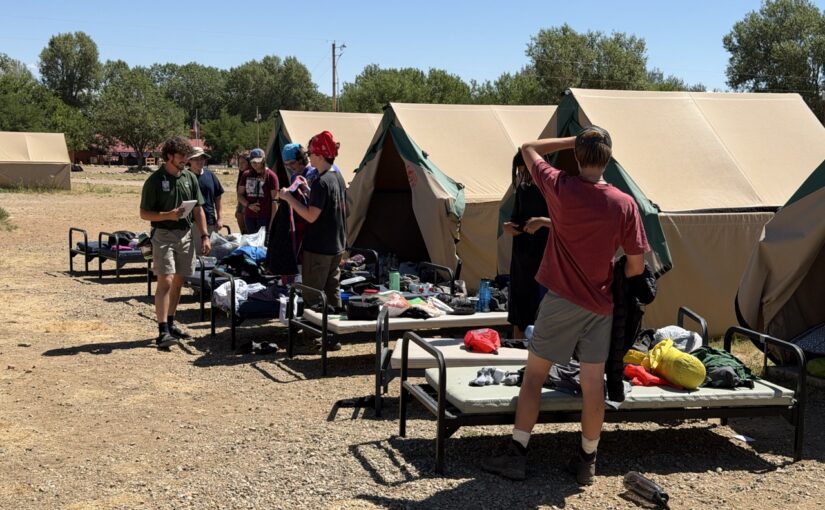
I did a 12-day1 Philmont trek in late July 2026, trek 12-12. I packed using the Philmont 2026 Guidebook to Adventure (p. 14), with some exceptions. My LighterPack inventory is at bottom.
The Philmont packing list is good. I recommend packing everything on it. I brought a few more things, described further down.
Before you take off hiking, you’ll review gear with your ranger. That is when you may choose to leave some items behind. It’s better to bring too much to Philmont and leave a few things at base camp than to lack essential equipment for a trek!
Table of Contents
I packed everything I needed
The Philmont list, plus a few extras (below), is comprehensive. I cannot identify anything I wanted to bring that wasn’t present.
A factor in why I had all I needed was because I packed towards the high end of ranges. If the list says “up to 4” of something, I brought four. If four is too many, you can leave some behind at base camp. By bringing four, I could make that choice!
On-list item commentary
This is a commentary on items on the Philmont packing list.
Items I left behind
Here’s the items on the Philmont list that I did not bring on the trek:
- Extra headlamp batteries. I had a Black Diamond Spot 400 Headlamp with its included non-rechargeable AAA batteries. I didn’t even chew through 1/3 of the batteries. Also, a trading post was available to me on day 6 in case I needed more.
- Long underwear. I left them at base camp. This was per our ranger’s recommendation, and he nailed it. At no point did I feel these were necessary. On the coldest mornings at 10,500 altitude, all I needed was a jacket until the sun was on me. While the trek felt warmer than I expected, possibly fueled by the extreme drought, I see a lot of reports of warm conditions from prior years, so I am unclear if the warmth was unusual.
- Lightweight fleece. It was unnecessary with my insulated jacket. This was great because my fleece wasn’t lightweight, just over 1 lb!
- Water filter. Based on the advice of my ranger, I left this behind, and we only used purification tablets. (I brought my personal filter for crew gear.) It was the right call. We rarely needed to purify water, and the water sources we used seemed pretty clean. That said, we saw two situations where, had we solely relied on purification, it may have been weird: 1. In the hike to Clear Creek, Rayado Creek became muddy during a rain. Purification tablets cannot clean up dirt. This wasn’t impactful because Clear Creek had treated water. 2. Bonito Creek felt like a cow toilet. Its watershed includes a lot of cow pastures. Will a filter work on the poop? Not sure. But seems like two kinds of treatment there would be desirable.
Items I should reconsider
These items I brought, but I am not sure they were useful:
- Camp/stream shoes. I am not sure these are needed. I got my first-ever pair of Crocs. They are a big “meh” overall, stupidly overpriced. A lot of days, I never took off my boots at night, and that was fine. Also, we encountered no streams that my waterproof boots were wrong for, but Philmont was under extreme drought at the time, which suppressed water levels.
- Sleep clothes. Never used them.
- Gloves and warm hat. Never used them.
- Camp Chair. My REI Flexlite Air Chair was a meh. It occasionally had minor usefulness, but that was 1.06 lbs that I could have dropped. I am not sure the weight-cost was worth it.
- Trekking poles. I can’t objectively say they benefited me. They may have helped catch a fall twice. However, there was no A/B test, so I don’t know if I would have carried myself better without the poles or if not, would have have caught the fall. The surprise was more that I had ordinary TrailBuddy poles, which aren’t particularly lightweight. They were fine! I had them on my backpack only the first trail day. The rest of the time, I was walking with them.
- Foot powder. This was crew equipment. Never needed it.
Items that did not work well
These items did not work well:
- Rubber tips for trekking poles. On day 8, hearing clicking sounds, I observed my poles had broken through both rubber tips. Except for hiking day 1 (trek day 2), I used the poles vigorously to transmit some forces from my legs to my arms.
Items that surprised me
These were items I got for this trip whose utility surprised me:
- Sleeping bag liner. It did well at protecting the sleeping bag from my nastiness. I washed it on day 7.
- 75L backpack. Several poo-poohed my choice of a 75L pack, saying it’s too large or too heavy. I found my Gregory Baltoro 75 it to be about right. On days where I needed to bear a bigger load, it made that possible. On other days, it easily cinched down to be a lower volume. (I got this at a considerable discount on closeout in the two years before our trek.)
- Sleeping bag. My Kelty Galactic 30 Sleeping Bag is a down hikers bag, rated to 30º. It was too hot most nights, which typically were 50º to 60º. The overheating was a contributor to mediocre sleep. That said, it got cooler the two nights we were above 10,000 feet (Clear Creek and Red Hills), and it was appreciated! (I got this at a considerable discount on closeout in the two years before our trek.)
- Rain pants. The time I didn’t wear them, I misjudged the rain storm. My boots got soaked! Wear them!
- Coghlan’s Snapfold Bowl. This lives up to the hype! It’s not a smellable, it’s light, and it snaps to a durable, flat shape. (Fozzils was the original brand of these bowls. It was acquired by Coghlan’s in mid-2024.)
- Jetboil. Someone else brought this. It was quite handy at warming up coffee water or miscellaneous, small hot-water needs. Far simpler than breaking out the MSR Whisperlite.
- Wool socks and sock liners. My wool socks seemed to hang on to water. When I washed clothes, they were always the last things to line dry. I want to investigate this further. But I had synthetic sock liners, too. These were among the first things to dry, so I imagine they did good at transmitting water away from my feet. Despite waterproof boots, with the sock liners and the wool socks, my feet never felt soaked, just sometimes slightly moist. (Exception: see the rain-pants item above.)
Beyond the Philmont list
These items were not on the official list, and I found them useful:
- Tent. Philmont recommends using tents they issue. I instead brought a Big Agnes Copper Spur HV UL2 tent. I tented alone as the odd adult male, and this was much lighter than the Philmont tent. (I got this at a considerable discount on closeout in the two years before our trek.)
- 1 gallon freezer bags. These were handy for on-trail clothes washing or containing stuff. I brought five.
- Power bank, Apple Watch fast-charging cable. I brought an Anker 20000 mAh power bank. It gave me a nightly charge of my Apple Watch Ultra 3 (got this used!). I also got occasional charging of my iPhone 17 Pro Max (also got this used). The Apple Watch charges were needed because I tracked our trail progress on all hikes. I was charging it from around 30% each day. Pro tip 1: remove the watch and charger when the watch is at 100%. I think there’s a parasitic drain from the induction charging if you leave it plugged in. Pro tip 2: Put the iPhone on low-power mode and on airplane mode. If you know you won’t use it for a few hours, power it off. I had to get exceptionally aggressive on power use starting day 5 as I had drained my power bank excessively due to my loose power management of the phone.
- Instant coffee. My staple was illy Instant Coffee Single-Serve Packets. They were fine. I’ve previously used Starbucks Via packets, and those are also good.
LighterPack inventory
I created this list before departing. I weighed all items individually.
Wow, you made it all the way here? If you want more Scouting content from a reformer angle, check Untended Fire. Many changes are needed if we want for BSA to have another 100 years.
- All Philmont treks include two days at base camp, so a 12-day trek is really 10 days in the backcountry. ↩︎
Thank you for this I found it to be very helpful!
I brought a Crazy Creek chair, which I rigged to the outside of my pack with shock cord and LOVED it. It was easy to get to, easy to put away, and kept my butt dry even when the ground was damp. I was the envy of my crew.
The one piece of gear that I brought and totally regretted was a water filter. It was COMPLETELY unnecessary with the micropur tablets. The filter only weighed about half a pound, but I still resented it every time I saw it at the bottom of my pack.
Thank you. I left off the filter, which is a “left behind” item. It is now added.