Design speed shouldn’t block higher speed limits

Thanks to a bill recently signed by the governor, the Texas Transportation Commission, which oversees TxDOT, may establish speed limits up to 85 mph on any state highway.

The bill uses the word “designed”. I’m afraid this may be misinterpreted to mean the civil engineering concept of “design speed”.

“Design speed” is not the maximum safe speed. It’s only a tool to guide road design. At best, it’s a conservative first guess of a speed limit; it’s often OK to set higher speed limits.

The TTC still has to change some rules before we can possibly see higher limits. They’ll probably adopt whatever TxDOT recommends. I sent the below letter to TxDOT to encourage them to not conflate the bill’s language with the civil engineering concept. I got a positive response, but the proof will come when the TTC adopts the speed zoning procedure revisions.

The letter:

HB 1201, which was just signed by the governor, allows the TTC to set a speed limit up to 85 mph on any road provided that “that part of the highway system is designed to accommodate travel at that established speed or a higher speed” and a standard engineering study was run.

This is a good thing. The old 70 mph limit was legislated in 1963. It’s now 48 years later, and 85 mph is perfectly safe on many roads with our drastically improved vehicle and road technology.

Here’s my concern: I hope the word “designed” in the revised statute will not be misinterpreted and become a roadblock to higher speed limits.

There is a concept of “design speed” in civil engineering. However, a design speed is a poor guide for a road’s true maximum safe speed for at least three reasons:

1. A road’s design speed that of its worst part. Suppose a 50 mph road has a 40 mph curve. By definition, the road’s design speed is only 40 mph. In the real world, the road should be signed at 50 mph, and yellow warning diamonds would be posted at the curve recommending 40 mph.

2. Design speeds assume characteristics of vehicles and road technology of the past. So a design speed established in 2011 will assume the inferior stopping distances, power, and safety of vehicles from many years ago. Even worse, most Texas rural roads were designed decades ago (e.g., back when cars had poor drum brakes, biased ply tires, weak horsepower, little safety equipment, dim headlights, no ABS or stability control, etc.). Design speeds established way back then will certainly understate what today’s on-road fleet can safely handle.

3. MOST IMPORTANTLY: Per the AASHTO, the design speed is merely “a selected speed used to determine the various geometric design features of a roadway”. Therefore, it is really only a theoretical/laboratory measurement. Its purpose is not to determine a speed limit.

The design speed must not be interpreted as a maximum possible safe speed. At best, it is only a conservative “first guess” of an appropriate speed limit; a road’s true safe speed may easily be higher.

To conclude, I ask that, as the TTC revises speed zoning regulations to accommodate HB 1201, that it not hamstring the speed zoning process with the civil engineering concept of “design speed”. Certainly in its use of “designed”, the legislature did not mean to invoke this specific concept. In doing so, Texas would misuse a theoretical, laboratory measurement whose purpose was never to be an absolute cap on speed limits.

(AASHTO is the American Association of State Highway and Transportation Officials.)

Left wing tripe

My church, First United Methodist Church of Dallas, has a Sunday school class afflicted with a radical left winger.

If you’re one of my Facebook buddies, you’ll remember this from January 9, 2011:

Wonderful, call a substantial portion of the electorate “stupid people”…

Now it gets more nerdy and nuanced. The same class now has this on its tackboard:

The point here is to get sympathetic liberals to hand-wring over military spending.

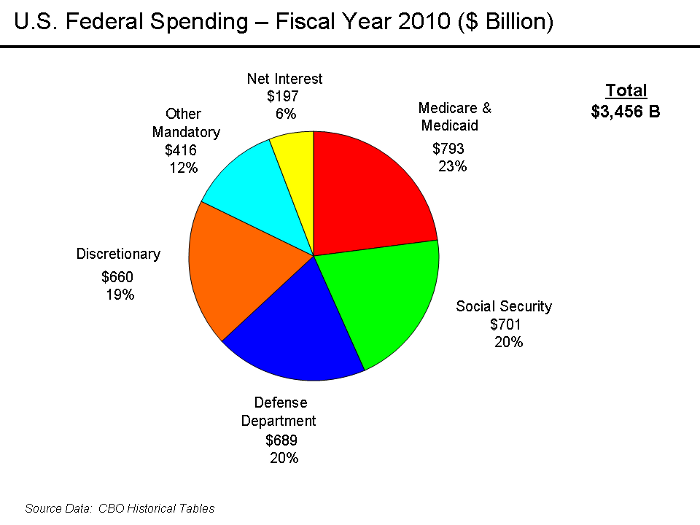
Except it’s a lie. It conveniently omits about 2/3 of federal spending!

Here’s a truer picture of federal spending:
(image source: Wikipedia image and article)

It’s more like 20% of federal spending!

Now, to be frank, while I believe in a strong defense, I am uncomfortable that the United States alone accounts for about 40% of worldwide defense spending. I’d like to scrutinize our defense spending, but I’m not going to lie about it with convenient numbers.

And I’m also not going to lie and slander in church.

Unwarranted stop sign near White Rock Lake

[This is a letter I just sent to a Dallas civil engineer asking him to remove a recently-installed, unwarranted stop sign.]

Mohammed,

Recently, an all-way stop sign was put up at West Lawther Rd. and White Rock Rd. on the west side of White Rock Lake. Through an open records request, I have received a copy of the warrants. I’ve attached those and your field observations to this email. [The warrants and field observations.]

I am concerned that this new stop sign does not meet the claimed warrants and therefore needlessly inconveniences road users, increases risk of undeserved traffic tickets, and created a hazardous situation.

The first warrant finds a need to control left hand conflicts. To prove this, I want to see obstructed sight lines, high traffic volumes, or some interaction of the two. In fact, none of this is a problem. I have driven through this intersection many times. Visibility is fine, and outside exceptional times (e.g., exceptionally-crowded events at White Rock Lake), the traffic volumes rarely require any wait for left turns. (Remember that traffic controls should be based on normal conditions, not outlier events for which the city already requires individualized, affirmative measures to control traffic.)

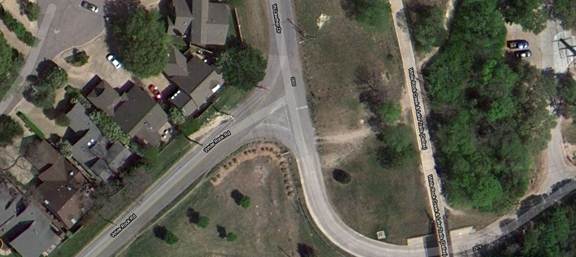
Here’s an aerial map from Google Maps:

This intersection only has two left turn conflicts: northbound White Rock Rd. turning left on westbound White Rock Rd. and southbound West Lawther Rd. turning left on southbound White Rock Rd.

There is no visibility problem for either left turn.

Left turn at northbound White Rock Rd. has no visibility problem either direction. Looking north while stopped at the stop line:

Looking west:

There is plenty of unobstructed sight to make a safe turn.

Southbound W. Lawther left turn to southbound White Rock Road also has acceptable geometrics to facilitate safe left turns.

This is the southbound W. Lawther view at the stop sign, looking south, and a little forward of the stop sign:

Traffic heading north, emerging from the park, will be going slowly. It will have just passed through a narrow railroad underpass, made a tight 90 degree turn, and will be slowing for a stop sign.

Same intersection, looking west:

Excellent visibility. Further note that eastbound cars may be approaching at less than the 30 mph speed limit. They will have just approached from an all-way stop at White Rock Rd. and Winsted Rd. Additionally, the traffic will be slowing for the sharp curve anyway; a 25 mph advisory speed is posted for eastbound traffic around the curve.

Here’s the irony: this all-way stop creates two new hazards:

  1. The stop sign encourages left-turning SB W. Lawther traffic to stop further back. Compare the following photo to the prior one of the intersection:

    Note that I was actually stopped a few feet pastthe stop sign; had I been stopped with the front of my car at the sign, as required by law, I would have even worse view of oncoming traffic. Additionally, eastbound traffic approaching on White Rock Rd. now has a worse view of southbound W. Lawther traffic. Below is a picture I took approaching on eastbound White Rock Rd.; the white car has already completely passed the stop sign before it became visible to me.

    Normally, this is roughly where rational motorists would stop before taking a left turn. The stop sign pushed this point further back.
  2. Left-turning southbound W. Lawther traffic used to only have to monitor one direction: eastbound White Rock Trail traffic. Thanks to the all way stop, southbound W. Lawther traffic has to negotiate both directions as all directions have equal right of way. This ambiguity causes confusion, which causes crashes.

Your own field observation confirms the absence of a traffic volume problem. In 30 minutes, you recorded 74 vehicles pass through the formerly uncontrolled part of the intersection (vehicles coming from EB White Rock Rd. or SB W. Lawther). That means the mere 9 cars approaching the intersection from the park have, on average, 24 seconds between potentially conflicting vehicles. Clearly, there is no problem here with traffic volumes.

The second warrant is whether there is a need to control vehicle/pedestrian conflicts near locations that generate high pedestrian volumes. Again, this warrant is unmet.

Given our relatively dry conditions over the past few months and no sidewalks, “high pedestrian volumes” will be readily apparent with grass trails. Indeed, you do see a pedestrian path on the south side of White Rock Rd. while west from the intersection:

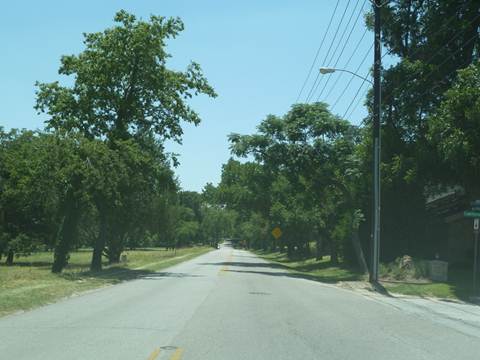
But the rest of the intersection is notable for its lack of pedestrian activity. Here’s the view headed north from the intersection:

In other pictures in this document, you’ll find no additional evidence of pedestrian usage of the intersection.

A satellite photo makes it even clearer:

The only pedestrian traffic is heading west from the elevated trail (old railroad right of way), heading west to cross White Rock Rd. a few car lengths south of the intersection, then continuing west along the south side of White Rock Rd.

On top of that, there’s not even a valid reason for pedestrians to cross the intersection—the other side only has the fenced backs of houses, and safer crossing points exist within less than a minute of walking in either direction.

Given that the in-intersection pedestrian traffic is minimal, possibly nonexistent, and that there is no compelling reason for pedestrians to cross the road in the intersection, and safe alternative crossings are a brief walk away, if in-intersection pedestrian traffic is even considered a problem, it would be better to just ban pedestrian crossings at the intersection.

The third warrant asks whether there is a visual obstruction that will prevent safe vehicle movement unless conflicting directions are required to stop.

As clearly demonstrated above, the only visual obstructions were created by the all way stop.

To conclude, the all way stop sign at White Rock Rd. and W. Lawther Rd. meets no warrants, and it makes the intersection less safe. I respectfully ask that you revert the intersection to its prior state, where only northbound White Rock Road, emerging from the park, had a stop sign.

I look forward to hearing from you.

Sincerely,

Aren Cambre

Texas Senate Republicans violated own party platform

This is a great example of the stupidity of a lot of the Texas Republican Platform.

From page 9 of the 2010 platform:

We oppose any constitutional convention to rewrite the United States Constitution. We demand the Legislature rescind its 1977 call for such a convention. We call upon other states to rescind their votes for such a convention.

This is Eagle Forum-style, nut job paranoia. They fear that a 31 year old concurrent  resolution, calling for a balanced spending amendment, can somehow result in a runaway constitutional convention and rewrite the US Constitution.

No kidding. They really believe this.

Here’s the 31 year old resolutions: HCR 31, Regular Session, and HCR 13, 2nd Called Session.

Now here’s the irony: the current (82nd) Senate did almost they same thing: they called for a constitutional convention for a balanced budget amendment.

A balanced budget amendment is silly; it won’t fix anything because runaway spending is simply taken off budget. That’s what happened with Social Security and Medicare.

But it doesn’t matter. I doubt enough states will call for this convention. And while we’re waiting, the Texas Eagle Forum and Phyllis Schlafly disciples will have another dumb cause to rabble rouse over.

Do projects matter for IT?

Visit http://ericbrown.com/do-projects-matter-for-it.htm for a recent article I wrote on projects in IT.

Two emerging trends:

  1. Projects don’t well-explain IT’s value to the business, and it’s getting worse.
  2. Work that is best organized as a classical (waterfall) project may not be valuable to your business. If you can’t express the project as an agile project, you’re probably doing something either quite complex or really vanilla. Either way, it’s not where IT is going.

Provoked? Read the article!