Sodded the Back Yard

For about 12 grueling hours, two in-laws, my wife, and I sodded the back yard with Palmetto St. Augustine grass.

At 7:45 AM Miller Grass delivered six pallets of sod. Each pallet is 63 square yards, or 567 square feet. Six pallets are a whopping 3402 square feet!

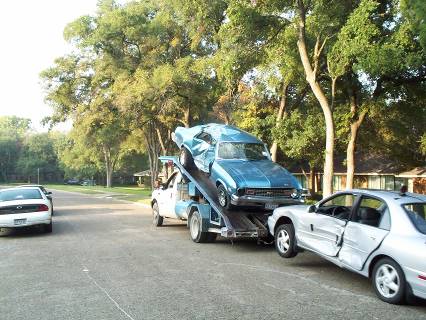
Our Palmetto pallets are the rearmost ones on this truck:

Here’s what the yard looked like before we started (click on it for a larger version):

Notice the playground area and other junk on the yard.

Here is a progress check at around 2:00 PM:

Did you notice that the playground area is gone?

As we got through the first pallet, I noticed that it covered disturbingly high percentage of the yard. I freaked out and estimated that I somehow bought 50% more sod than needed.

We took a careful look at this playground area and decided to just rip it out and grass it over. The equipment was decrepit anyway, and the playground area’s mulch was mostly worn out and eaten up. All the junk on the right side of the yard is from this playground area.

Even after making this decision, I was still concerned that we would be left with two unused grass pallets. I called Miller Grass and asked if they would buy back the two pallets, but they were understandably not interested. Sod is like take out food. Once the food is prepared for you and it’s in your possession, you can’t just take it back. Miller Grass referred me to a landscaper who needed two pallets of grass for Sunday. I called the landscaper, and he offered me 50% of my cost for the grass.

Fast forward to 6:30 PM:

We’re done, and better yet we used every last piece of grass! The landscaper didn’t get to buy a thing.

My original plan was to solid sod a third of the yard, checkerboard sod another third (the area already had some grass), and leave the rest alone (the remainder had healthy St. Augustine or was the play area). Well, it turns out that after sodding the playground area, we had exactly enough grass to solid sod the entire yard, not including the area with healthy St. Augustine. What incredible luck! For a price that I thought would give me enough to halfway finish the yard–and leave a trashy “playground” in the middle of it–I now have a stunning back yard. The difference between before and after is astounding!

The thing that I am most proud of is that I personally unloaded at least a third of the grass from the pallets into the back yard. It was one of the most difficult jobs I have ever done, and I am exhausted. But considering that 3½ weeks ago I was in the emergency room after a bad crash, this is a major accomplishment.

By the way, that grass stunk of cow manure.
Grassing up the back yard

When we bought our house, we inherited a mess of a back yard. A third of it was overgrown with periwinkle, a fifth had neglected St. Augustine grass, and the rest was just trashy, weedy grass. The flower beds were almost bare and compacted by constant beating of 3 dogs, there are metal parts everywhere (from a nutty guy who lived here for a few decades), the yard was full of trash trees, dirt was piling up against the bricks, and so on.

This Saturday we are correcting the grass problems: we are sodding 3000 sq ft of the former periwinkle and trash grass areas of our back yard.

To prepare, a few weeks ago we killed off the periwinkle with Ortho glyphosate, and this Sunday I shaved the trash grass with my mower’s lowest setting.

There are two variants of St. Augustine grass commonly sold in the Dallas area: Raleigh and Palmetto. Both varieties are resistant to St. Augustine decline virus. The Palmetto variety has several superior characteristics to the Raleigh, one of which is possible enhanced drought tolerance because of an apparently deeper root system. It also has a better appearance and is more cold and damage resistant. Since it’s only 10% more expensive, we chose the Palmetto variety. We are using Miller Grass, a local sod supplier.

Last night we got 320 lbs of topsoil from our local Lowe’s, and today we got another 800 lbs. We are using this to raise a depressed area of the back yard and enhance water flow away from the house.

After you lay the sod, you have to keep it thoroughly wet for at least two weeks. Dallas has an ordinance restricting watering between 10 AM and 6 PM from June 1 through Sept. 30. I filed for a variance from Dallas’s water regulations today; hopefully they will respond quickly!

Amazing Variance in Tree Service Cost

A June storm forced our hand on our trash trees. We had to remove one large hackberry tree, we chose to remove another hackberry (was choked off with vines), and we elected to remove 9 other small hackberrys before they get out of hand and a Carolina cherry laurel that was growing too close to the house.

We got four estimates before we had the tree work done:

Name Job & Insurance Coverage Cost (tax not included)
Dallas Tree Surgeons
703 Valencia St.
Dallas, TX 75223
972-633-5462
Everything. Web site says “insured for your protection.” $3400
Sam Hill Tree Care
PO BOX 170304
Irving, TX 75017-0304
972-251-4235
Everything. Carries liability & workman’s comp. $2000
Herbst Tree Services
1600 Stonecrest Trail
Wylie, TX 75098
972-487-5986
Everything except haul off trees. Carries liability but not workman’s comp. $1925
Preservation Tree Services
660 Preston Forest Center, #137
Dallas, TX 75230
214-528-2266
Everything except stump grinding. Web site says “fully insured.” $3850

The variance in these prices is astounding. The company we ended up choosing, Sam Hill Tree Care, is properly insured and accredited and came in as almost the lowest price. The most expensive company was nearly twice as much! When you’re talking thousands of dollars, that is a huge difference, bordering on exorbitance.

It pays to shop around!